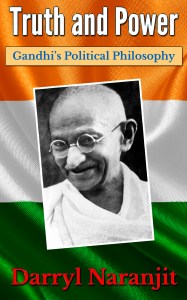
 Truth and Power

Mahatma Gandhi was a revolutionary thinker. Underneath the simple words and phrases that appear almost as platitudes, there is a meaning, a philosophy that challenges modern Western thought at its core. This book is written as an attempt to uncover the meanings hidden in those simple words and phrases.
Gandhi used the term satyagraha to name the strategy and philosophy he was using. The word satyagraha literally translated means ‘truth-force’. On September 11, 1906, in South Africa, Gandhi explained his use of the term. “None of us knew what name to give to our movement. I then used the term passive resistance in describing it. I did not quite understand the implications of passive resistance as I called it. I only knew that some new principle had come into being. As the struggle advanced, the phrase passive resistance gave rise to confusion and it appeared shameful to permit this great struggle to be known only by an English name. Again, that foreign phrase could hardly pass as current coin among the community. A small prize was therefore announced in Indian Opinion to be awarded to the reader who invented the best designation for our struggle. We thus received a number of suggestions. The meaning of the struggle had been then fully discussed in Indian Opinion and the competitors for the prize had fairly sufficient material to serve as a basis for their exploration. Shri Maganlal Gandhi was one of the competitors and he suggested the word Sadagraha, meaning firmness in a good cause. I liked the word, but it did not fully represent the whole idea I wished it to connote. I therefore corrected it to Satyagraha. Truth (Satya) implies love, and firmness (agraha) engenders and therefore serves as a synonym for force. I thus began to call the Indian movement Satyagraha, that is to say, the Force which is born of Truth.”
The question is why did he use this term. Was there, in Gandhi’s mind, a power associated with truth, a power that could bring down the British Empire? What is the relationship of truth to power? Nietzsche, arguably one of modern Europe’s most influential philosophers, has examined this relationship quite rigorously. Gandhi, therefore, may be compared with Nietzsche who is perhaps the most radical of modern western thinkers. They are, however, on opposite sides of the fence. Gandhi champions the “moral order” of the universe; Nietzsche dismisses it. Indeed the gist of this book is that Gandhi presupposes a cosmic spiritual struggle between good and evil, a struggle that takes place in the minds of human beings. It is a struggle between two opposing philosophies, two ideas, two world-views – a struggle between light and darkness, truth and untruth.
Nietzsche thinks that truth is merely the intellectualization of the ‘will to power’; he has been considered the foremost ‘philosopher of suspicion’. In comparing these two thinkers, it can be claimed that Gandhi turns the ‘hermeneutic of suspicion’ unleashed by Nietzsche on morality, on its head. This is the key to understanding Gandhi and this is what makes him probably the most revolutionary of thinkers. Whereas Nietzsche excludes himself from the probing light of the ‘hermeneutic of suspicion’, Gandhi subjects every modern position to this suspicion.
Nietzsche’s ‘hermeneutic of suspicion’ had subjected every post-Socratic philosophical position, every philosophical foundation, and all morality, to skepsis. His historical genealogy sought the genesis of morality in the ‘will to power’. All ascetic ideals were attempts to weaken and to destroy the affirmation of life. Nietzsche points to a struggle between life affirming forces and life denying forces, a struggle that occurs throughout history and in the history of thought.
For Nietzsche what is life affirming is all that enhances the ‘will to power’. For Gandhi, life affirmation is the discovery of the self as distinct from the ego. The self is the source of power; this is, of course, the classical Indian philosophical position. Nietzsche and Gandhi thus stand on opposite sides of what constitutes power. For Nietzsche, the ‘will to power’ is constrained and negated by conventional morality. What passes for morality, from this point of view, is a means of weakening the strong. For Gandhi, on the other hand, finding the true self means mastering the ego, and this is the source of power. These opposing viewpoints stem from different ideas about what is real and about what is true, and about the relationship of truth to power.
It is necessary to understand the differing ideas of how truth is related to power in both thinkers. For Nietzsche truth is related to power in the sense that every truth is an attempt of the ‘will to power’ to assert itself. For Gandhi, the self, the atman, is the source of power and of truth. What distinguishes these positions is the position of the will in the search for truth. Nietzsche locates the will prior to knowledge and in a sense directing knowledge, Gandhi thinks that the ego must be “reduced to a cipher” (i.e., the will must be ‘bracketed’, to use a phenomenological term) and truth is found only when the will is removed from the act of knowing, that is, when the self is found. The relationship of truth to power is crucial, therefore in understanding Gandhi’s philosophy.
 The philosophy of Darryl Naranjit